Website strategy: How is EEAT reframed from SEO to AEO, and what changes are necessary?
I don’t claim to be an authoritative source on this topic, but as most other marketers active on the internet I’ve not been untouched by the SEO vs AEO/GEO debate.
EEAT is an important concept for propping up an SEO strategy. It’s all about adding signals to show why a human would trust the content of a website. EEAT is also a way for search engine’s (most notably Google’s algorithm) to place more importance on websites with good EEAT signals, in particular in certain topical areas where human expertise is essential to build trust (related to finance or health).
Websites read as for human, by humans, that signal expertise and authoritativeness are highly regarded.
As part of working with website strategy for auditing and improving existing websites or rebuilding new ones from scratch, one must therefore take EEAT into consideration.
Below is my understanding of EEAT in the SEO context and the current AEO/GEO landscape. How I try to incorporate ways to work with these signals as much as you can without venturing too deep into copywriting.
SEO-framed EEAT
Let’s start with the foundations. SEO-framed EEAT still serves as the basis for what AEO/GEO builds upon. A solid foundation will get you pretty far.
This is all about creating content that is focused on the business that is behind the messaging, propped up by individuals to signal that it’s by real people.
The acronym E-E-A-T stands for:
Experience - Content that reflects first-hand use, observation, or practical involvement rather than abstract summaries. Consider in-depth blog articles or case studies with real “how we did it” explanations. Author bios in blog articles or highlighting names of contributors.
Expertise - Content that shows depth, accuracy, and subject-matter understanding, supported by identifiable and knowledgeable authors. Similar content as showcasing experience with in-depth articles or case studies, but also including verifiable statistics, subject-matter-expert input or other industry sources.
Authoritativeness - The site or author is referenced, cited, or endorsed by other reputable sources within the topic area. Think along the lines of the Mayo Clinic which is a highly cited an authoritative source within the medical field, and other similar industry focused publications. The optimisation happens mostly happen off-site.
Trustworthiness - The content is reliable, honest, well-maintained, and clearly connected to a real, accountable entity. The website has a clear entity behind it with contact details, there aren’t a bunch of 404-pages and broken links.
In short, incorporating E-E-A-T into SEO means:
- Writing content based on real experience
- Demonstrating topic knowledge clearly
- Identifying authors and their qualifications
- Earning external recognition (primarily through citations with links)
- Being transparent and legitimate
- Avoiding low-quality or misleading content
- Keeping information accurate and updated
The key question SEO uses these signals for is to determine Would a human trust this page?
The case for sprinkling EEAT artefacts throughout the website
The playbook for increasing EEAT signals of a website isn’t to rely on individual pages, but rather to incorporate artefacts that interconnect throughout a website. (Sounds fancy, no?)
For example, pairing shorter bios for a blog authors with an in-depth page outlining their topical expertise (past work experience, other publications) and links to articles of similar topics will boost the expertise signals.
Having in-depth case studies that highlight specific methods or softwares used showcase experience and expertise. The more tangible and precise, the better.
We build cohesiveness across the website by focusing on a limited number of topics or themes in blogs, service/product pages and case studies.
Repeating phrases, insights or implicitly/explicitly stated information helps build trustworthiness in our claims. For example, clearly surfacing corporate contact details in the site footer and not just the about us page or repeating industry certifications.
Other signals happen off page, namely citations/links from other sources. These can be built through partnership within the same space (collaborators or partners linking to each other) or earned (from exceptional content other’s want to bring attention to).
From my understanding, experts tied closely to your website (in-depth author bios or other visible website presence) can contribute to authoritativeness through guest articles or making appearances in podcasts or cited sources in other publications.
Examples of adding EEAT artefacts to the website
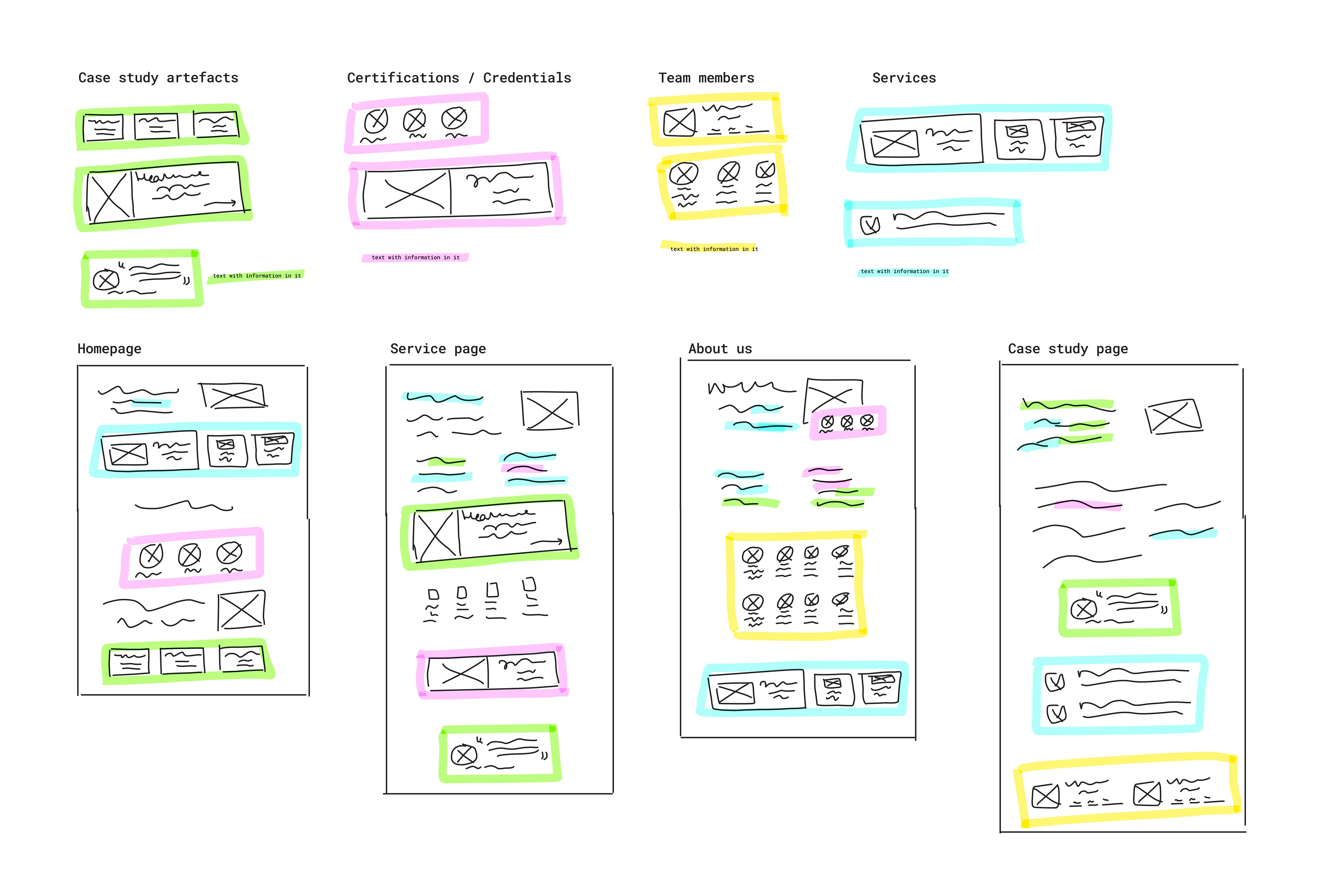
To weave EEAT into the website strategy, we’d therefore look at positioning content in the following ways:
- Case study listing pages that highlights key stats from linked case studies with clarity on when they were published.
- Creating original, first-hand insights (eg. research).
- Individual case study pages with emphasis on outcomes and enough in-depth explanation to showcase subject-matter expertise and experience. For example, specific mentions of softwares and of industry methods used. Each study should read as unique enough to not feel like a copy-paste of another with just the brand switched out.
- Blog articles having an author blurb to show why they are writing on the topic, with links to social profiles and preferably a link to an author overview page or listing view that collects further blog posts from the same writer.
- Author pages with extended biography, internal links to blog articles they’ve authored or case studies they’ve been featured in.
- Blog articles listing original publish date and “last updated” information to show freshness.
- List of key people in the organisation with names, titles, links to social media profiles; considering adding short bios to highlight why they matter in the context of the organisation.
- Contact details to the business in the footer (name, company address, company registration number) and on the about us page.
- Show real parts of products and user interfaces for software by incorporating screenshots, product photographs or videos (instead of using illustration).
Content strategy behaviours
This is not a set-and-forget state. It required regular maintenance and upkeep to:
- Retire or update old and outdated or factually incorrect pages and content pieces
- Work with off-page SEO to get citations, links, PR-mentions in trade/industry magazines
- Update photos as products evolve and change
- Review links to ensure there are no 404s (missing pages) and tighten technical SEO
The shift in focus with AEO
Answer Engine Optimisation (AEO) and Generative Answer Optimisation (GEO) (Sidenote: Most industry experts consider these to be related but distinct concepts where one tries to influence short-form answers/snippets and the other is to work information into the AI-respoinse made up from many different sources) still rely heavliy on the SEO input and signals we’ve all been building and optimising for so far. I’d say that the slight change to EEAT is to place more heavy emphasis on the personal aspect of expertise and experience rather than rely on the business entity behind the website.
For SEO you’d capture searches: “The best agency for B2B websites” and it’d use website signals and off-page signals (links, mentions) to surface a specific page. It’s a battle of SERPs (Seach Engine Results Pages), to get better placement near the top.
For AEO/GEO it gives replies in text rather than surface a specific page. So the name of the game is to influence what the LLM spits back as a reply to the question. Most playbooks heavily involve reinforcing key messaging across the website and the internet. Repeat phrases/snippets for positioning that is then cited verbatim by the LLM.
The connection to EEAT then?
AEO/GEO in part utilises search results to get input for certain questions. Better EEAT and placement influence what is shared.
But also, LLMs and AI build out mental models, or knowledge graphs of information. Nodes are little islands of information, businesses or people, and they are connected to each other through the graph.
AI will use information to create the knowledge map of entities and how they relate to each other. One node can affect a closely related node. It doubles down further on topics: Who has shown demonstrated experience and expertise in this topic?
Strong EEAT signals makes the AI more likely to extract and cite information. Strong nodes of individuals behind a corporation means more chances to get cited.
The shift in EEAT emphasis
This shifts the narrative from:
The Company shows expertise in the service area of topic and the content is highly related to the search query.
To:
The Company represents a network of known experts, each associated with specific skills, work, and outcomes for providing services on focus area.
It underpins the need for futher attributing expertise, experience and topical authority to the people behind the business.
AEO/GEO friendly EEAT artefacts
Assuming the basics are in place, we slightly tweak some EEAT artefacts and add some new tactics to make it work even better for the AEO/GEO context:
Experience - Attributed participation in real outcomes. Name the people part of building the company’s experience.
Expertise - Repeated association between a person and a topic. Highlighting on-page and off-page contributions to a topic or area can help boost signals.
Authority - How central an entity is within a topic graph. This is helped by cross-linking or mentioning them across the website.
Trustworthiness - Identity clarity.
Key question: Can an AI confidently reuse this knowledge? Does it understand who this person/company is, what they are known for, and how that connects across the web?
Some additions to the earlier EEAT strategies for content are therefore:
- Name real people of the business and attribute work to them
- Tie people to projects and outcomes
- Be explicit in text about demonstrated skills and expertise. For example, case studies does not just name specific methods and tools utilised but also
- Repeat patterns and snippets across pages and themes that can be cited by AI
- Clear link text with phrases that the AI can pick up on for topicality, eg: Learn more about our marketing services.
- Make relationships crawlable by using links and cross-link people and specialties
Examples of how to incorporate EEAT
Here are a few examples to make it more explicit on how to incorporate EEAT into the website structure, taking AEO into consideration.
Case study listing + individual pages
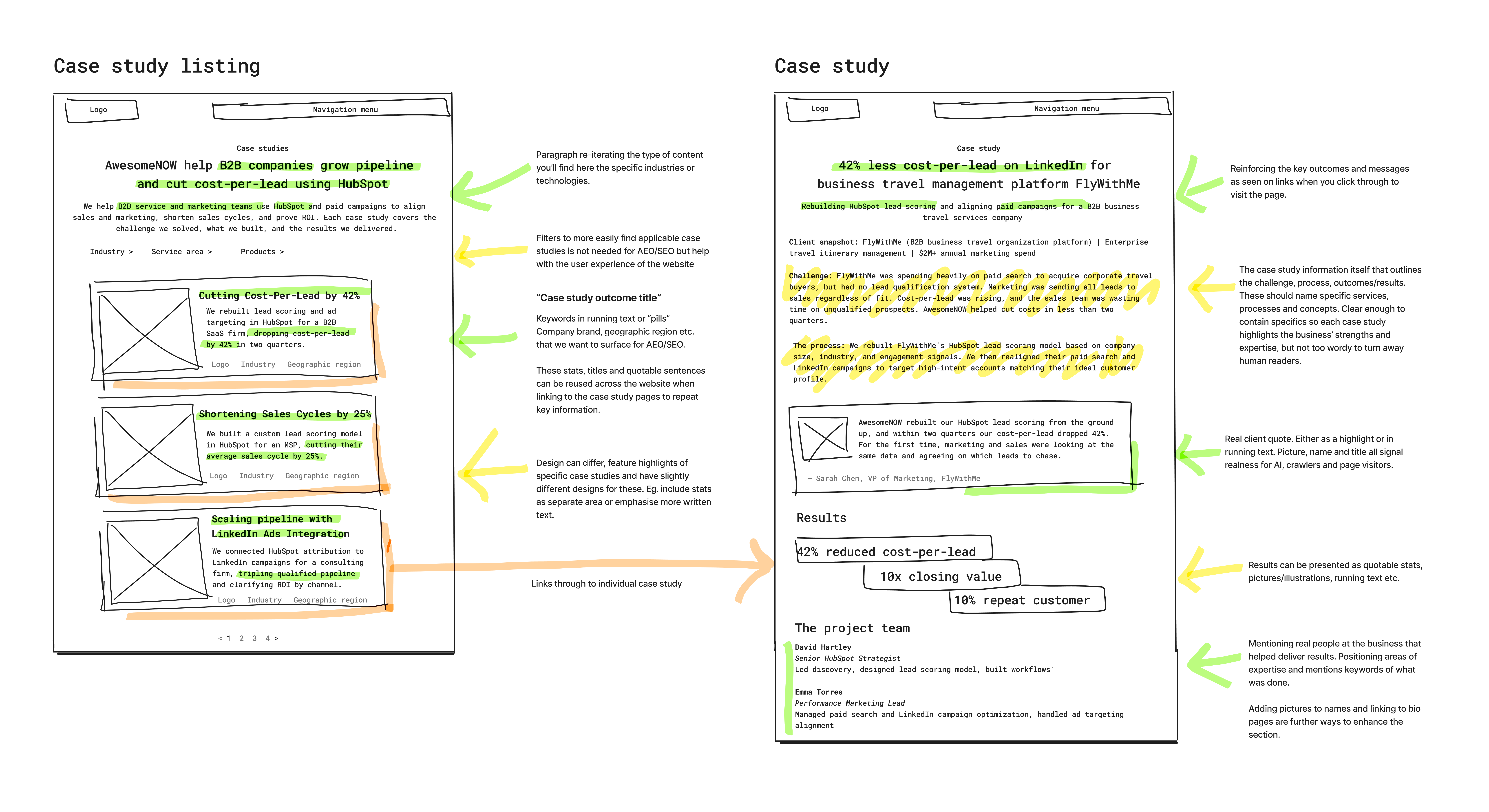
These exist as a pair. An overview page that presents and lists case studies, and then the individual case studies themselves. They can of source have different names such as portfolio, work, client examples, or success stories, but all aim to do the same thing: show experience in a given field.
The overview/listing page should:
- Use clear snippets that frame the client case study: industry, specific tools or skills employed, stats or outcomes
- Areas complementing the listing: headline explanation that ties back to the central service/product areas, positioning statements
For the case studies themselves, as previously mentioned they ought to be detailed enough to read as unique. They can still follow a similar fomula, but the details and results presented
- Feature client testimonials, quotes or interview videos with named people at the company (who, their title and/or role at the business)
- Clear mention of products/services and how they helped to achieve specific outcomes Sidenote: This can be a good opportunity to also add cross-links to product/service pages for better keyword anchors for SEO or discoverability for web visitors
- Clearly outline use case or problem (this ties well into AI-search where users ask specific questions)
- Consider adding named personell who delivered the work for the case study. It should include their names, titles, roles on the project and could link back to team member pages to further build the knowledge nodes about their expertise
- Feature images of products or other supporting visual material (this included customer testimonials or video case study)
- Ensure clear naming of platforms, companies, tools and concepts
Blog articles
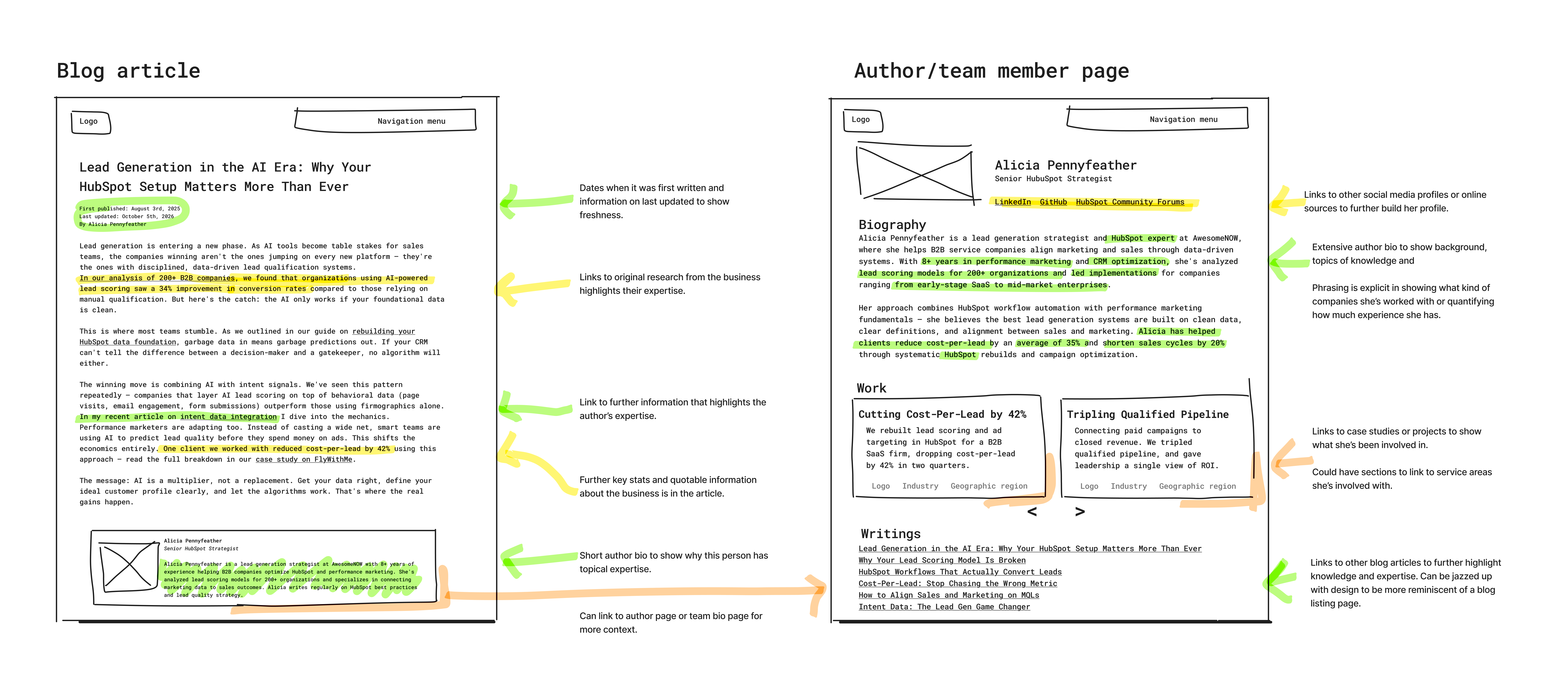
The blog article page should:
- Have a publish date, and preferably a “last updated” tag to show how recently the content was updated
- An About the author section or short bio with image, author name, link to the author page
- The bio itself should be explicit as to why this person has topical expertise to write this article
- In the article body, add clear references to other articles to signal expertise: Author has analysed topic X…
- Transparency around use of AI: add a notice if AI has helped write or create meaningful portions of the page content
Author or team member page
This kind of page is a perfect node in a graph on who this person is and what they know. It can be done as an extension of a blog post author bio to increase cross-linking of related articles, serve as a team member presentation or page that is split out from the company’s about us page, or serve as a combination of the two.
- Format copy to make it easy for AI to pick up key phrases to reuse in AEO answers
- Make experiences more concrete by adding statistics and modifiers, eg.: …treated hundreds of patients with condition and regularly consults on cases regarding scenario.
- Extensive biography (compared to blog post bio)
- Use natural languages when explaining and listing topics. Repeated phrasing is more easily picked up by LLMs rather than just the topic title.
- Internal links to other content they are featured in divided by topic. For examples case studies or projects they’ve worked on, links to services they cater to or collected links to blog articles they’ve written
- Consider linking to off-site content as well: social media pages, personal blogs/websites/portfolios or guest posts they’ve written or interviews they’ve been featured in.
- List or explicitly mention certifications and qualifications such as academic degress or industry credentials.
About us page
The company’s about us page is a perfect place to boost trustworthiness and authoritativeness:
- Write the legal name, organisation registration number and physical location address
- Display industry certifications and couple it with written information (just the visual isn’t as reliable as also mentioning in plain text) and make sure they are linked to the issuing body Sidenote make sure to have citeable snippets here, positioning the certification title + what it means + why it matters, eg: We are ISO 27001 certified to protect sensitive data, manage cyber risks and work safely with client information
- Identify key people within the organisation with name, title or role and preferably a short bio (and/or link to team member page). Adding links to social media profiles can also help strengthen the node (eg. a designer’s Behance profile or developer’s GitHub overview)
- An area for press coverage, which can be spun off into a separate page
- Information about the company’s background, history, growth and milestones
- Outline information about product testing, servicing
What about other pages?
Depending on what kind of industry, goods/services, and offering, the page lineup will look slightly different between websites. Also consider other type of pages such as:
- Pricing page
- Product category (listing) pages and individual product pages
- Industry pages
- Service pages
- Knowledge hubs with content (downloads or ungated)
The previously mentioned ways to weave in EEAT onto pages can, and should, also be employed here. Real images of products, clear overviews of service methodology and transparent explanations of pricing structure are all helpful in boosting EEAT-signals.
One thing to remember is that for AEO the AI/LLMs seem less likely to crawl through and extrapolate information from related pages, so we repeat key information wherever it makes sense to do so.
Final words
This playbook is one I’ve employed in past projects for website strategies in B2B settings mostly focused on servicing of different kind. Treat it as a basis for adjusting for other settings to make the most out of it.
Some areas are easier to slap on top of an existing website (like adding sections, rewriting headlines), while others require more substantial shifts (setting up team member pages, adding author information to blog articles if not already present) to complete revamps (redoing past case studies for new focus, creating new journeys across the website). Changes should be made with a clear plan and path in mind.